Pakistan’s IT services exports reached $3.4 billion in FY2025-26. The next challenge is moving from services growth to globally scalable technology companies.
For years, Pakistan’s technology story was presented primarily as a story about potential.
A young population.
Freelancers.
Software developers.
Startups.
Digital connectivity.
Now the conversation is becoming more concrete.
Pakistan’s IT industry is increasingly becoming an export story.
According to the Pakistan Economic Survey 2025-26, IT services exports grew 19.8% to $3.4 billion, accounting for 46.1% of total services exports. The government report notes that IT services exports surpassed readymade garments and the total value of other manufactured-goods export categories in the period covered.
That is not merely a technology statistic.
It is a structural shift in Pakistan’s export economy.
IT Is No Longer a Side Story
The State Bank’s half-year assessment provides another important perspective.
ICT exports reached an all-time high of approximately $2.2 billion in H1 FY2025-26.
Computer services accounted for 84% of ICT exports and telecommunications services for 16%.
The SBP also noted that ICT exports represented around half of total services exports during the period.
This means technology is increasingly contributing to Pakistan’s external-sector earnings.
Unlike many traditional exports, digitally delivered services can be sold internationally without the physical movement of goods.
That creates a fundamentally different scaling opportunity.
The Freelancer Economy Is an Asset
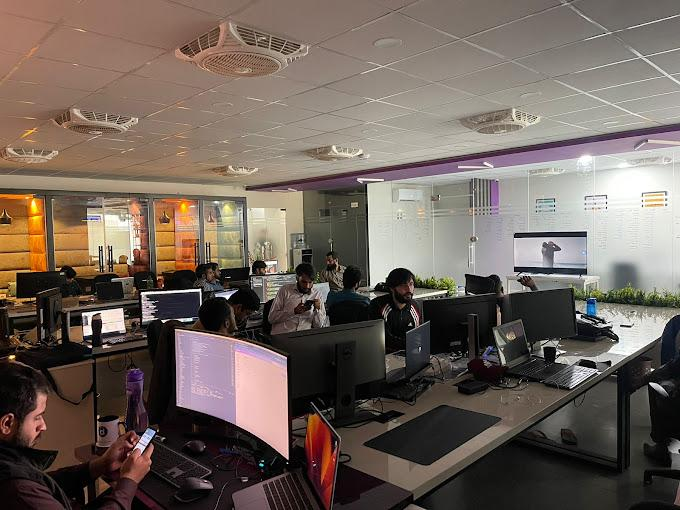
Pakistan’s digital workforce is already significant.
The State Bank reported that approximately 2.3 million people, or 2.9% of overall employment, were digitally employed or working as gig workers according to the Labour Force Survey 2024-25.
This represents an important competitive asset.
But there is a difference between having millions of people earning digitally and building a globally competitive technology industry.
The next phase requires moving up the value chain.
From:
Freelancing
to:
Software companies
to:
Specialised technology services
to:
Products
to:
Global platforms
That transition will determine how large Pakistan’s technology opportunity ultimately becomes.
Regulation Is Beginning to Adapt
The regulatory environment is also evolving.
In April 2026, the SBP introduced measures designed to simplify export-realisation procedures for IT companies and freelancers.
One important change was the removal of the requirement for IT exporters and freelancers to submit Form R for every individual export transaction, replacing it with a one-time declaration under the new framework.
This may appear like an administrative detail.
It is actually important.
Digital businesses compete globally not only on talent.
They compete on ease of doing business.
If receiving international payments, managing documentation or complying with export procedures is unnecessarily complicated, the competitive position of Pakistani firms weakens.
Pakistan Is Also Betting on AI
Artificial intelligence is becoming the next major layer of the technology economy.
The Ministry of IT and Telecommunication has described AI as a national priority and has outlined a roadmap involving a proposed $1 billion investment by 2030, 1,000 scholarships and an ambition to upskill one million non-IT professionals.
These are policy ambitions rather than achieved outcomes.
That distinction matters.
Pakistan has not yet demonstrated that it can capture a major share of the global AI value chain.
But the direction is significant.
If AI is adopted by Pakistani exporters, manufacturers, banks, retailers, logistics companies and professional-services firms, the impact could extend well beyond the technology sector.
The Bigger Opportunity Is Productivity
The strongest AI story for Pakistan may not be creating another AI startup.
It may be making existing businesses more productive.
Imagine a textile exporter using AI for demand forecasting.
A bank using AI for fraud detection.
A hospital using AI-assisted diagnostics.
A logistics company optimising routes.
An agricultural enterprise using predictive analytics.
A software company automating development processes.
The economic value of AI will ultimately be measured by productivity.
Not by the number of AI conferences.
Infrastructure Is Improving, But Scale Requires More
Pakistan’s ICT Development Index score improved from 56.4 in 2025 to 67.7 in 2026, according to the Ministry of IT and Telecommunication, with a reported 20% relative improvement.
That is encouraging.
But technology competitiveness requires more than connectivity.
Pakistan also needs:
Reliable electricity
Affordable high-speed internet
Cloud infrastructure
Data centres
Cybersecurity
Specialised talent
Research capacity
Venture capital
Intellectual-property protection
and access to international customers.
The Scale Problem
This is where Pakistan's technology industry now faces its most important challenge.
The country has demonstrated that it can generate technology exports.
The next question is whether it can build companies that scale.
A $5 million software company is valuable.
A $100 million software company is transformational.
A technology company serving global markets at billion-dollar scale can change how an entire country's economy is perceived.
Pakistan needs more of the latter.
Boardroom View
Pakistan's technology sector has already crossed an important psychological threshold.
It is no longer simply a sector with potential.
It is a meaningful export industry.
The next phase should therefore not be about proving that Pakistan can write software.
Pakistan needs to prove that it can build global technology businesses.
That means moving from talent arbitrage toward intellectual property, specialised services, products, platforms and global brands.
The opportunity is real.
The question is whether Pakistan can scale it.