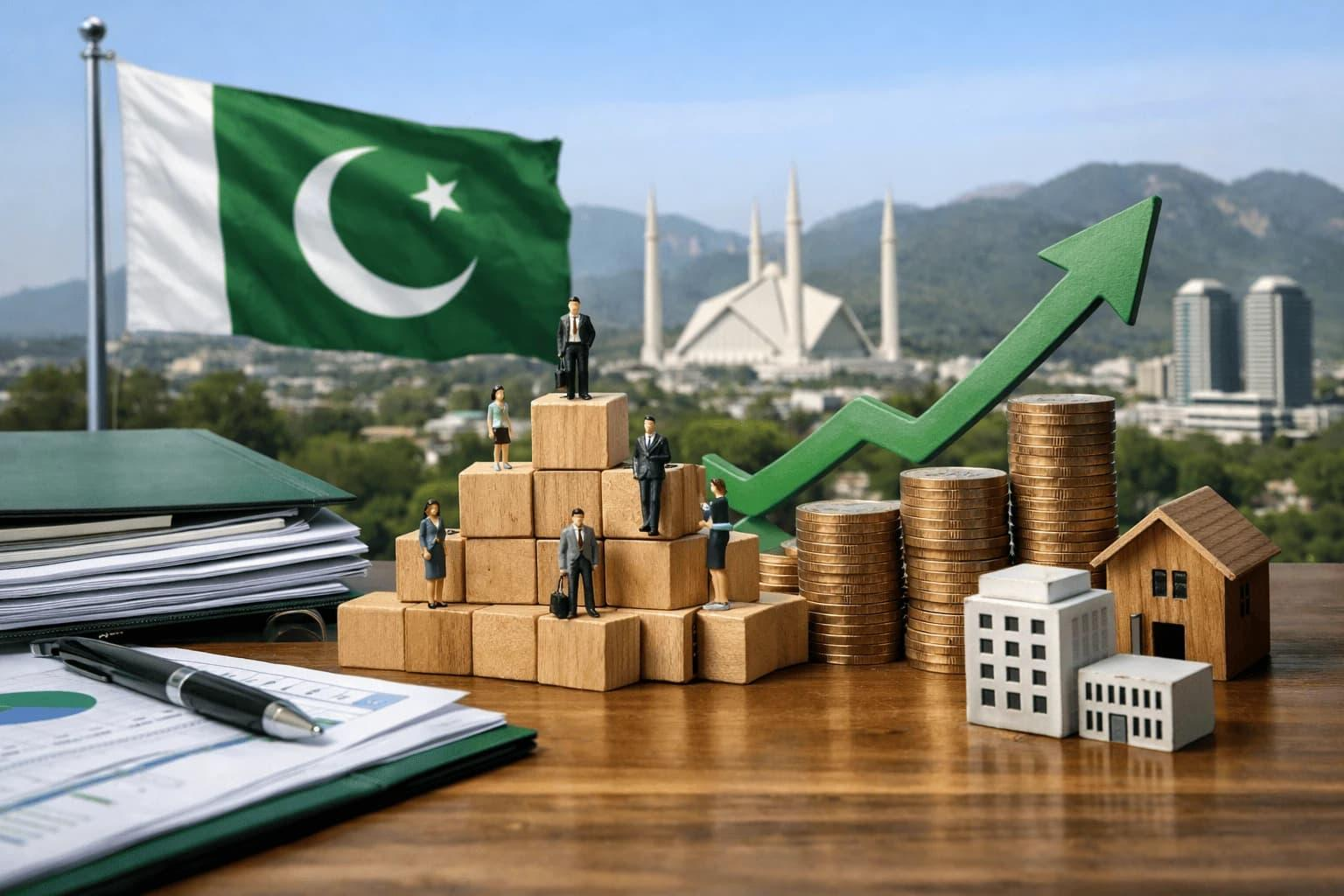
Pakistan has moved from economic stabilization toward a more important challenge, building sustainable private-sector-led growth through investment, exports, innovation and jobs.
By Murtaza Subhani
Founder & Editor-in-Chief, Boardroom Publication
Pakistan has spent the last few years answering one difficult question:
How do we stabilize the economy?
Now, a more important question is emerging:
Where will the next wave of growth come from?
Stabilization matters. It creates breathing space. It restores confidence, improves external-sector management and gives policymakers room to think beyond immediate crises.
Pakistan’s economy grew by 3.7% in FY2025-26, according to the Pakistan Economic Survey. Private investment also increased during the year, while macroeconomic conditions showed signs of improvement. citeturn0search3turn0news41
But stabilization is not prosperity.
It is the foundation for prosperity.
And this is where the private sector must now take Centre stage.
The Government Cannot Be the Growth Engine Forever
For decades, Pakistan has repeatedly looked towards the government to create growth.
Build infrastructure.
Create jobs.
Provide subsidies.
Attract investment.
Support industries.
Protect businesses.
These functions will remain important.
But government cannot permanently substitute for a productive private sector.
A sustainable economy is ultimately built by businesses that invest capital, create products, hire people, develop technology, enter international markets and take commercial risks.
The government can create the conditions.
Businesses have to create the growth.
That distinction needs to become central to Pakistan’s economic thinking.
The Next Phase Must Be Investment Led
Pakistan does not simply need higher consumption.
It needs higher productive investment.
A household buying another consumer product may support demand for a day.
A company building a new factory can create employment for years.
A technology company entering an international market can generate foreign exchange.
A pharmaceutical company investing in local manufacturing can reduce import dependence.
A logistics company expanding its network can improve the competitiveness of hundreds of other businesses.
This is why private investment matters so much.
The recent increase in private investment is encouraging, but the challenge is to make that momentum durable. The IMF has also noted that lending to the private sector had begun recovering from a low base, with private-sector credit growth reaching 15% year on year in February 2026. citeturn0search34
The question now is whether this recovery can become a sustained investment cycle.
Pakistan Has No Shortage of Entrepreneurs
One of Pakistan’s greatest economic strengths is often underestimated.
Its entrepreneurs.
Look at the number of businesses being created.
Look at technology exports.
Look at the growth of digital businesses.
Look at family-owned enterprises.
Look at SMEs operating across almost every sector of the economy.
Pakistan does not lack people willing to take risks.
What it lacks is an ecosystem that allows successful businesses to scale.
An entrepreneur may be able to start a company.
The harder question is whether that company can become a large employer, exporter or regional player.
That requires access to capital, predictable regulation, skilled talent, reliable energy, digital infrastructure and functioning markets.
From Survival to Scale
For too long, the conversation around Pakistani businesses has been dominated by survival.
How do we manage the electricity bill?
How do we manage taxation?
How do we manage currency volatility?
How do we manage imports?
How do we manage financing costs?
These are legitimate concerns.
But a growth economy requires a different conversation.
How do we expand?
How do we export?
How do we become more productive?
How do we adopt AI?
How do we enter new markets?
How do we attract investment?
How do we build globally competitive companies?
This is the mindset shift Pakistan now needs.
Exports Must Become a Corporate Priority
Pakistan cannot build sustainable growth by relying primarily on domestic demand.
The country needs foreign exchange.
And foreign exchange ultimately comes from exports, investment and remittances.
The technology sector provides an important example.
Pakistan’s IT and IT-enabled services exports reached approximately $4.6 billion in FY2025-26.
That achievement demonstrates that Pakistani businesses can compete internationally.
But imagine if the same ambition existed across pharmaceuticals, engineering, processed food, agriculture, textiles, minerals, financial services, logistics and creative industries.
Pakistan would not merely be exporting more.
It would be building a broader export economy.
The Role of Government Must Evolve
This does not mean the government should step back.
It means the government should become better at enabling.
The priority should be:
Predictable policy.
Competitive taxation.
Reliable energy.
Efficient regulation.
Better infrastructure.
Access to finance.
Export facilitation.
Human-capital development.
Rule of law.
The government’s recent emphasis on attracting private investment and strengthening the business environment reflects this direction. Discussions with international investors, including the Silk Road Fund, have increasingly focused on export-led growth and greater private-sector investment. citeturn0news6
But policy announcements alone will not be enough.
Businesses ultimately respond to what they experience on the ground.
We Need More Long-Term Thinking
One of Pakistan’s biggest economic weaknesses has been the short-term nature of decision-making.
Businesses think about the next quarter.
Governments think about the next budget.
Investors think about the next interest-rate decision.
Markets think about the next headline.
Countries, however, need to think in decades.
Where should Pakistan’s manufacturing base be in 2035?
Which industries can become global exporters?
What skills will our workforce need?
How can Pakistani companies become regional champions?
How can domestic savings finance productive investment?
How can technology transform productivity?
These are the questions that should increasingly define economic policy.
The Private Sector Must Also Look in the Mirror
There is another side to this argument.
Businesses cannot demand a better environment while avoiding responsibility for their own competitiveness.
Pakistani companies need to invest in governance.
They need better management.
They need technology.
They need professional talent.
They need stronger financial reporting.
They need succession planning.
They need to move beyond personalities and build institutions.
Family businesses, in particular, must increasingly make the transition from founder-led enterprises to professionally managed organizations.
The companies that survive the next decade will not necessarily be the ones with the biggest assets today.
They will be the ones that can continuously adapt.
Pakistan’s Growth Story Cannot Be Government vs Private Sector
This should not become an ideological debate.
Pakistan needs both.
Government provides the framework.
Private enterprise provides commercial energy.
Government builds public infrastructure.
Businesses build productive capacity.
Government establishes rules.
Businesses innovate within them.
Government creates stability.
Businesses turn stability into investment and employment.
That is the economic partnership Pakistan needs.
The Moment Has Changed
Pakistan has spent considerable effort moving away from crisis management.
Now comes the harder part.
Growth.
And growth is ultimately measured not by speeches, announcements or policy documents.
It is measured by factories being built.
Companies expanding.
People being hired.
Exports increasing.
Products reaching foreign markets.
Technology improving productivity.
Capital being invested.
And businesses becoming stronger than they were the year before.
Pakistan has an opportunity to enter this next phase with a different mindset.
Not:
“How do we avoid the next crisis?”
But:
“How do we build the next decade?”
That requires confidence from policymakers.
Ambition from entrepreneurs.
Patience from investors.
And accountability from corporate leadership.
The government has an important role to play.
But it cannot build Pakistan’s next growth cycle alone.
The next wave of growth has to come from businesses that invest, innovate, hire and export.
And if Pakistan gets that equation right, economic stabilization will not be remembered merely as the period when the country avoided another crisis.
It will be remembered as the moment when Pakistan finally created the foundation for sustained private-sector-led growth.
Murtaza Subhani’s View
Stabilization gives Pakistan breathing space. Private enterprise must now use that space to build.
Disclaimer: This article represents the author's opinion and is intended for discussion and thought leadership. Economic statistics and references are based on publicly available institutional and reported sources. It should not be interpreted as financial or investment advice.