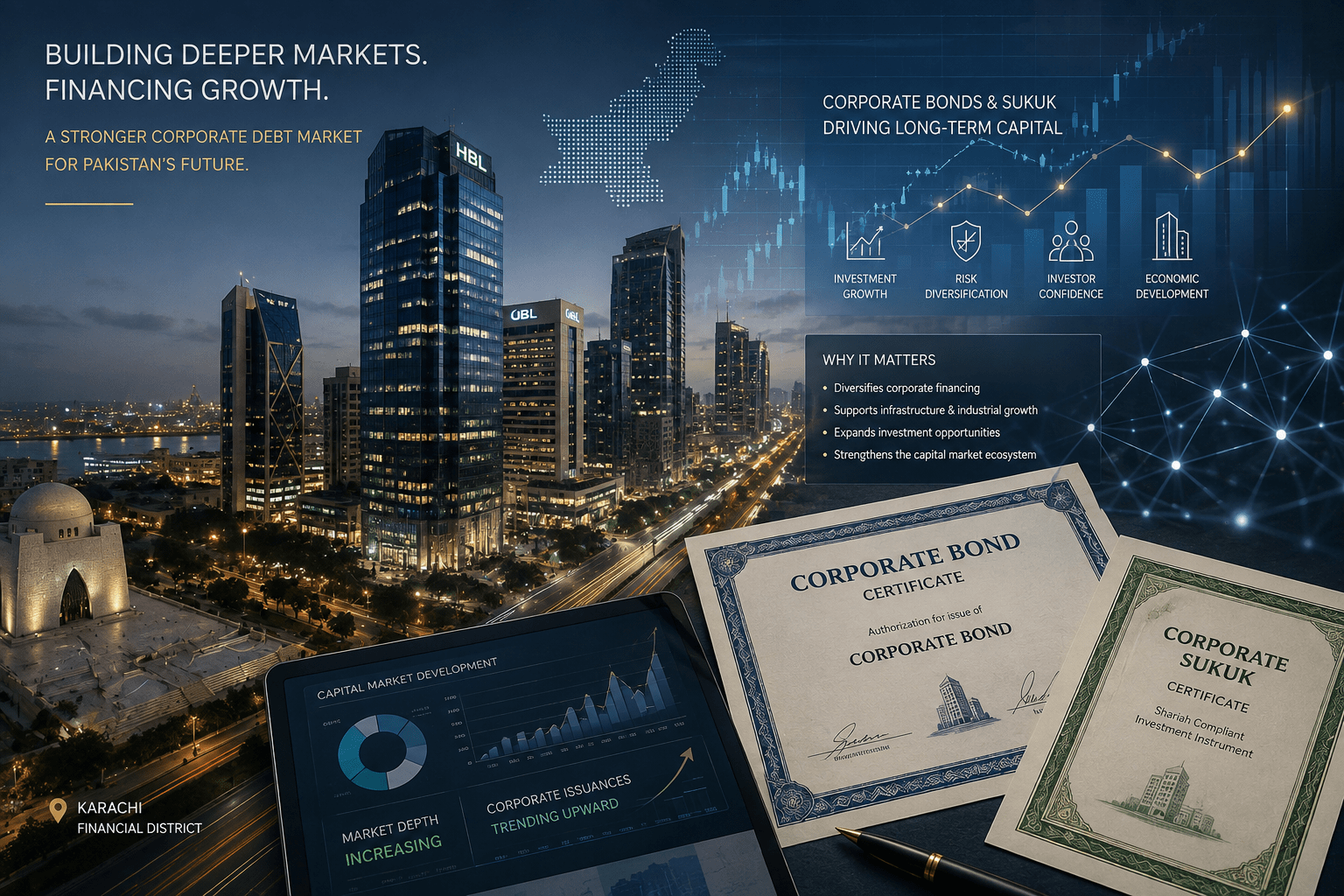
SECP has launched reforms to deepen Pakistan’s corporate debt market. Could bonds and Sukuk become a larger source of long-term corporate financing?
By Boardroom Research Desk
For decades, Pakistan’s corporate financing model has relied heavily on banks.
Companies seeking expansion capital have generally approached commercial banks for loans, while the country’s bond and Sukuk markets have remained relatively less developed.
That may be changing.
The Securities and Exchange Commission of Pakistan has constituted a high-level working group to review the regulatory framework governing the corporate debt market and recommend reforms.
The objective is clear:
Give Pakistani companies more choices when they need long-term capital. Associated Press of Pakistan
Why Corporate Debt Matters
A modern economy requires multiple channels of finance.
Banks are essential, but they cannot realistically carry the entire burden of financing corporate expansion.
A company building a power plant, expanding a manufacturing facility, developing large-scale infrastructure or financing a long-term project may require capital over many years.
Corporate bonds and Sukuk can potentially provide that capital directly from investors.
The basic model is straightforward.
Company → Debt Instrument → Investor Capital
Instead of relying entirely on:
Company → Bank → Loan
A deeper debt market therefore creates diversification.
The Regulatory Problem
According to the SECP’s reform initiative, market participants have identified lengthy issuance timelines and high issuance costs as important obstacles.
The working group is expected to review the existing framework and recommend practical reforms. It will also examine issues related to credit ratings and the overall issuance process. Associated Press of Pakistan
This is important because corporate debt markets depend heavily on efficiency.
If issuing a bond is expensive, slow or complicated, companies may simply choose bank financing.
Investors then have fewer opportunities.
The market remains shallow.
And the cycle continues.
Sukuk Could Be Particularly Important
Pakistan has a significant Islamic-finance ecosystem.
That creates an opportunity for Sukuk to become a more prominent component of corporate financing.
SECP has also recently issued a practical guide aimed at facilitating corporate Sukuk issuance.
This indicates that policymakers are looking beyond conventional debt instruments and attempting to broaden the range of financing structures available to businesses. SECP Pakistan
For companies, this could eventually mean greater flexibility.
For investors, it could create additional income-oriented investment opportunities.
The Investor Side of the Equation
A debt market cannot develop simply by encouraging companies to issue bonds.
There must also be investors willing to buy them.
That requires:
Transparency
Reliable financial reporting
Credit assessment
Liquidity
Investor protection
Clear pricing
Institutional investors, mutual funds, insurance companies, pension funds and other long-term investors could potentially become important participants.
Retail participation could also develop over time, particularly if digital platforms make fixed-income products easier to understand and access.
What It Could Mean for Businesses
A deeper corporate debt market could change corporate finance strategy.
A large company might combine:
Bank financing
- Equity
- Bonds
- Sukuk
- Internal cash flow
Instead of depending almost entirely on bank borrowing.
That diversification can become particularly important when banks tighten lending conditions or when companies want to lock in longer-term funding.
It could also reduce the pressure on banks to provide every form of corporate capital.
The Capital-Market Connection
Corporate debt-market reform is not separate from Pakistan’s broader capital-market development.
It is part of the same ecosystem.
SECP has already reported stronger investor participation, a 48% increase in stock-market investor accounts during FY2025–26 and renewed efforts to increase the country’s investor base. It has also approved new IPOs and recently targeted broader capital-market participation. SECP Pakistan
The logical next step is to give those investors more instruments.
A mature capital market should offer more than equities.
It should provide:
Equities
Bonds
Sukuk
Money-market instruments
Mutual funds
REITs
and other structured investment products.
Can Pakistan Build a Real Corporate Bond Culture?
That will depend on execution.
Regulatory reform is necessary.
It is not sufficient.
Companies need to become comfortable with capital-market disclosure.
Investors need confidence.
Rating systems need credibility.
Issuance costs need to become competitive.
Secondary-market liquidity needs to improve.
And the overall legal framework must provide confidence to both issuers and investors.
If these pieces come together, Pakistan could gradually develop a financing system in which companies are less dependent on traditional bank lending.
Sector Outlook
The corporate debt-market initiative deserves attention because it addresses one of Pakistan’s deeper structural economic weaknesses.
An economy seeking higher investment needs deeper capital markets.
Deeper capital markets require more instruments.
And more instruments require both issuers and investors.
The opportunity is therefore much larger than simply creating a bigger bond market.
It is about building a more diversified financial architecture for Pakistan’s growth economy.
Boardroom View
Pakistan cannot build a larger corporate economy with a narrow financing system. The next phase of growth requires companies to have more ways to raise capital and investors to have more ways to deploy it.
Disclaimer: This article is for educational and journalistic purposes and does not constitute investment advice. Corporate debt and Sukuk involve credit, liquidity, market and other risks.