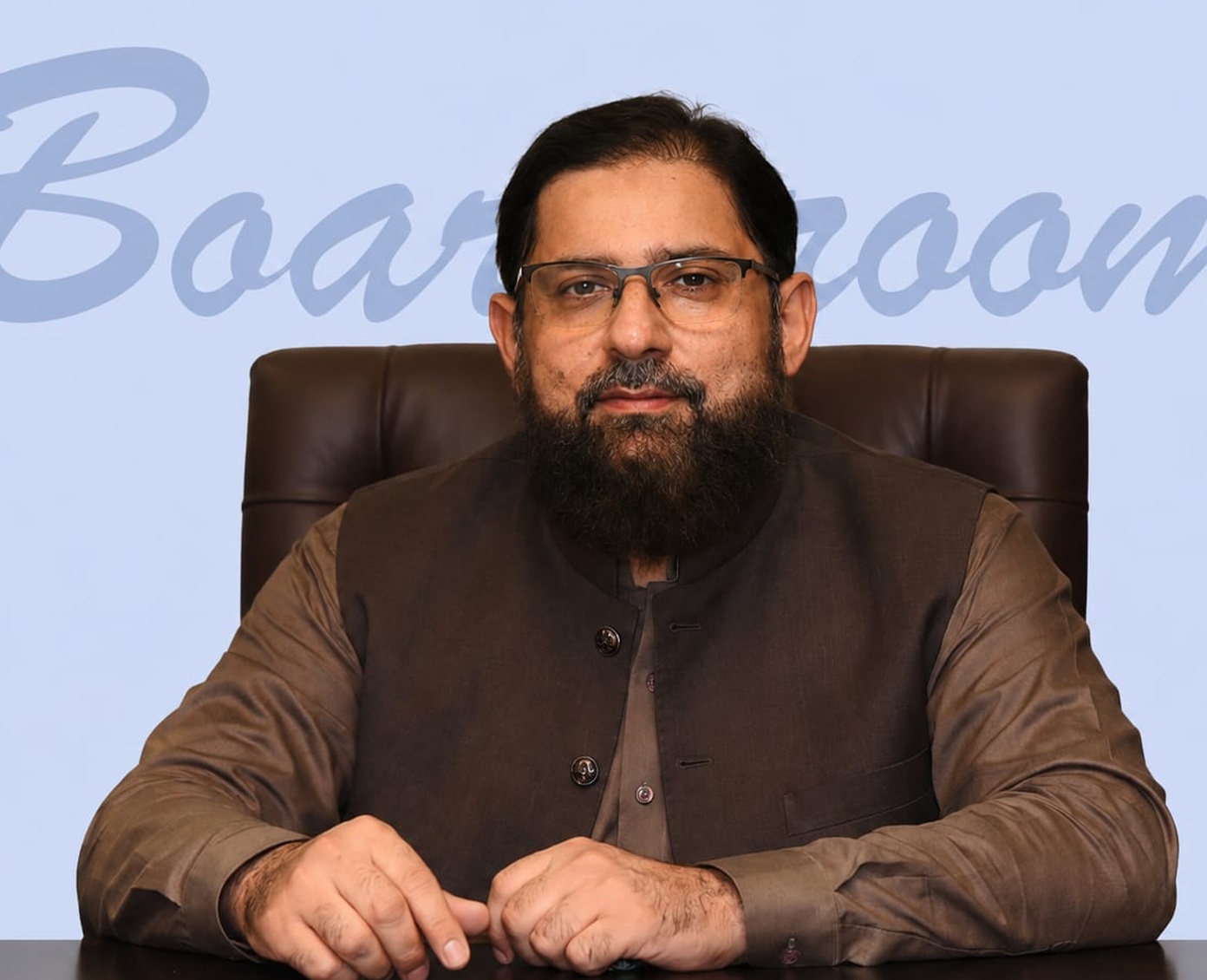

Shireen Naqvi is a seasoned Organizational Development trainer, consultant, and entrepreneur with over three decades of experience across private, public, development, political, and education sectors. Passionate about people and ideas, she specializes in leadership development, team effectiveness, cultural transformation, and strategic retreats. Her interventions focus on unlocking human potential by moving beyond ego-driven barriers toward conscious, values-based growth. Shireen has also pioneered youth-focused initiatives, promoting confidence, humility, and self-reliance. As an entrepreneur, she has championed social enterprises empowering differently-abled youth. With diverse projects spanning women’s entrepreneurship to smart cities, she continues to inspire purposeful leadership and transformative change.
Boardroom: Can you briefly describe your professional background and areas of expertise?
Shireen Naqvi: From OD (Organizational Development) trainer and consultant to entrepreneurship – it has been an exciting journey so far. A love affair with people, ideas and goal. 32-years of living on purpose, driven by ideals and in the quest for more challenges to add the thrill and spice. Areas of expertise being any intervention that addresses the deep-seeded human condition of traversing from a blind state of ego (fear and self-aggrandization) and unexplored potential, to a purer state of piety; a healthy spirit; live by consciousness; make decisions on conscience. These have so far included leadership; effective teams; craft a meaningful culture; project management, besides strategic retreats. With the youth (ages 13 to 24 years), interventions have been similar with greater focus on how to build confidence and humility; self-reliance and resourcefulness; clarity of future with action in the present. Areas dabbled with are as diverse as Reproductive Health; Women entrepreneurship; Build Smart Cities and Youth Leadership. Now we are entering the 7 to 10 year old arena with a Plus Bag where parents and children learn to develop their PQ (Practical Quotient).
As an entrepreneur; have been hands-on into setting-up and running a bakery, restaurant, tailoring shop, art-work for greeting cards, all done by hearing impaired and mentally challenged youth. Setup and managed a souvenir shop at the Karachi Museum and celebrated Pakistan’s scenes and people printed on t-shirts, sold from Hunza to Karachi.
Boardroom: What sectors or industries have you primarily worked with?
Shireen Naqvi: Sectors I’ve worked with are Private; Public; Development; Political and Education.
Boardroom: What are some common challenges you have observed in businesses across various sectors?
In my area of work, the challenges seen in businesses relate to people. The enormous variance in the psychological, emotional and logical premise of people can be a driver or hindrance in performance, depending on how these are managed. The main cause is that managers follow paradigms of the 19th century, which they learnt in business schools or are methods used by their seniors. These are thoroughly outdated. Rarely is there knowledge and practice of how to manage and lead people in the 21st century. Worse is the way Millennials and Gen-Z are managed, let alone prepare for Gen-Alpha that is going to flood the market within a decade. Expectations are the same, but the process of getting people to perform have altered. There are plenty of resources; whether in Pakistan or any other country; yet the scarcity mentality stifles how we can ignite the human will and create an environment that is empowering. Leaders do not want to ‘let go’. Insecurities regarding authority and control stem from deep-rooted causes of lack of confidence, which has profound causes of its own. These then manifest as arrogance, ascribing blame, indiscipline, personality-centricity and, above all, fear.
Boardroom: How do you tailor your consulting approach to meet the unique needs of each client?
Shireen Naqvi: Clients take primarily two approaches: The curative or preventative. Training is either to establish a desired culture, normally when a company has designed a new vision. This can also be around a new company strategy that will need a different mindset; develop a skill required in the near future or a situation that may arise as a consequence of change management. This preventive approach is rare. Mostly L&D’s stance is toward being curative, i.e. a problem has arisen in the culture; or shortage of skill; or a new strategy was implement and resistance to it took form. Our recommendation to our client is that we conduct an assessment around their verbalized requirements. Why? Because often what the HR department perceives is from their perspective; the CEO or leadership team sees it differently and the workforce views it in another way. Assessments are time consuming and costly, as they require conducting focus groups, one-on-one interviews and/or the entire population’s survey. Results of these enable us, as consultants, to narrow down on the true causes of the challenge at hand. This ensures improved diagnosis and effective treatment. If this route is not the company’s priority then we probe deeply into what HR says and design programs around their perceived requirements. Once we begin the program, there are effective ways to probe further, through our participants, on their perceived causes. This enables us to additionally tailor the program on-ground.
Boardroom: Can you share a particularly impactful project or success story from your consulting experience?
Shireen Naqvi: All the Leadership 360-degree assessments I have conducted for mostly senior managers have been very effective. Other stories include awareness building projects by the corporate sector on health mindfulness for primary school children; or a national program to build tolerance; or even as simple an assignment as to assess how the workforce want their office premises to be improved.
Boardroom: What trends or changes do you see impacting businesses in the near future and how can businesses adapt to these changes and stay competitive?
Shireen Naqvi: The power and force of AI is going to do it. It already is. Highly qualified professionals see themselves becoming redundant very soon. Most of these professionals use AI as an enquiry tool; but AI Natives are a whole different story. They are using AI as the workforce of their start-ups. These include teenagers who are taking the very concept of the corporate sector by storm. Any company’s major budget expense is its people. Can you run a company without people? The new answer is ‘Yes’; AI provides the people. We need to be far far more agile in how we view our future as professionals. Till such time as robotics take over the hands-on tasks of a plumber or electrician; we, as people doing mental jobs, are not safe in our comfort areas. Companies who will quickly switch to the AI mode of running their business will not only stay competitive, they will lead markets and even transform into monopolies.
Boardroom: What advice would you give to businesses looking to scale or expand their operations?
Shireen Naqvi: Just like oil and gas companies constantly explore the Earth for more natural gas and oil reserves, so must companies explore markets to scale and expand. Often companies, especially large ones, become deeply entrenched in their hierarchy and bureaucracies; i.e. day-to-day trouble-shooting; managing inflection arising due to global economic changes in currency rates and fuel prices; interstate conflicts; altered government regulations. Rigid focus on these factors make companies insular. Sure, many have business development departments that do a reasonable job of innovation and locating new markets. Yet, in this century, disruption and creative destruction need to be embedded in the company’s DNA. At the very heart of the matter is how courageously critical is the company of itself. How agile is it to adapt; does it accept its vulnerability; how resilient is it to withstand change? Malcolm Gladwell wrote extensively in his book ‘The tipping point’ about the ideal size of a company or community for them to thrive. Sure we can make an elephant dance, yet that’s the only move it will make no matter what the circumstances. In a new situation, the effort and time (cost and speed) needed to adapt will be phenomenal.
Thus, go out and explore. Keep your fingers on the pulse of the customer (not only your own, but globally). Customize your offerings. Stay connected with or ahead of market dynamics. Expand deeper, not just wider. Diversify into un-thought of areas – do not say, “This we have not done before, therefore cannot do it now.” That is exactly why you should do it NOW.
Boardroom: How can businesses balance short-term needs with long-term strategic goals?
Shireen Naqvi: Short-term goals are derived from long-term goals. There has to be a connect, else they may conflict with each other and tilt the balance. Whether companies set goals, objectives, milestones, or at the higher level, strategies; these are a cause-effect to each other with one leading to the higher level aim in their hierarchy for success. If there is an imbalance between them it could be because of a new/different situation that arises, causing a change in the short-term goal to tackle the current situation. Even then, changes to short-term goals and their ramifications must be seen through the lens of what is defined in the long-term goals, else both will be out of sync.
Boardroom: What are some key performance indicators (KPIs) that businesses should track to measure success?
Shireen Naqvi: These depend on the priorities of the organization and its vision, values and strategies. The recommended method is not only to measure current performance, but also to visualize what is needed in the fast changing future. Organizations set KPIs or performance metrics that are quantitative (dollarizing the end results) and qualitative (based on company values). These are conventionally 60:40 respectively or, at times 70:30. This is a good practice. However, this can be 40:30:30, i.e. “quantitative: qualitative: aspired skill” to make people take upgrading their skills seriously.