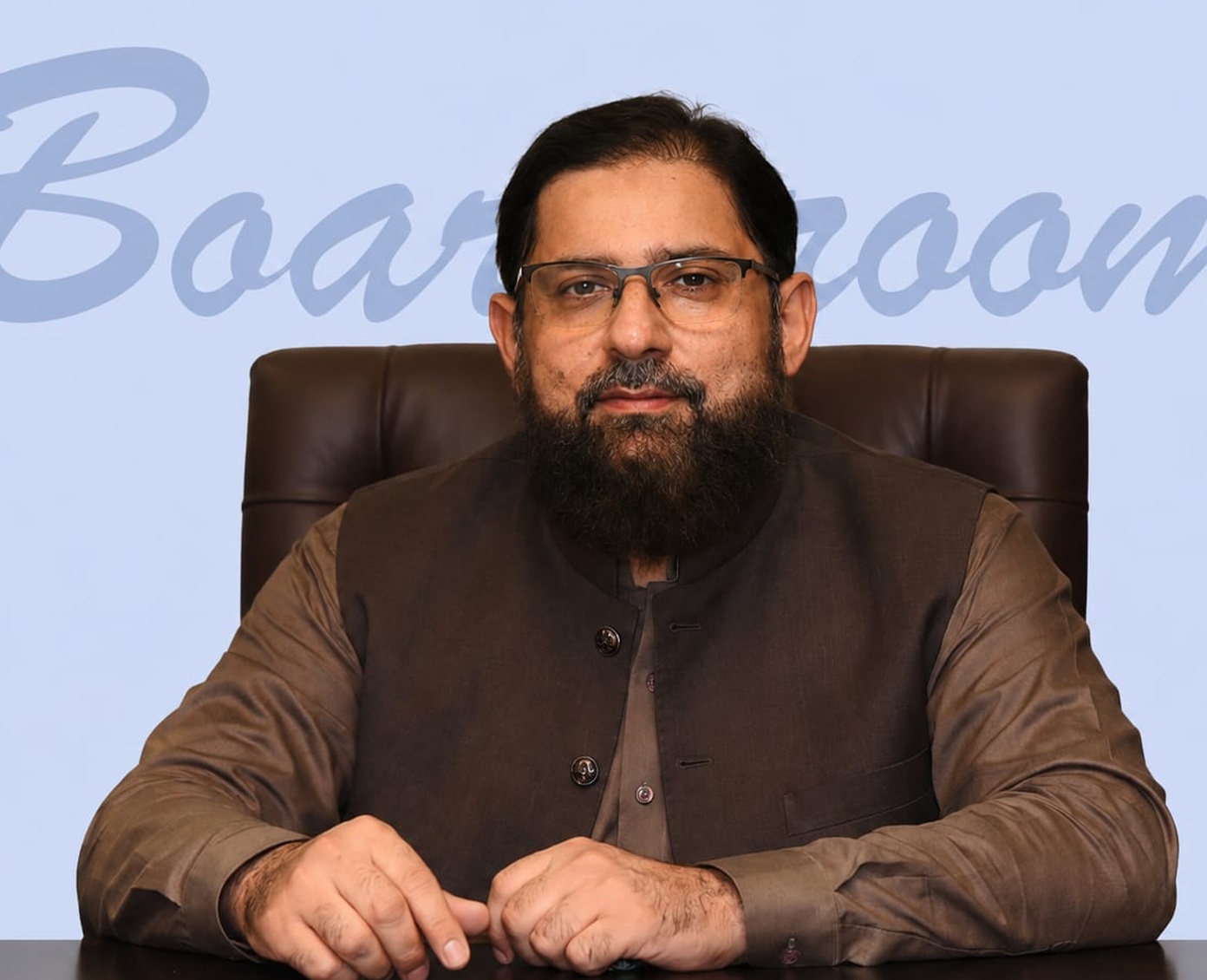
From Karachi to Wall Street, Mir MAK embodies resilience and conviction. Raised in a family rich in faith and intellect, he draws inspiration from his grandfather, Syed Ali Asghar Bilgrami, former Governor of Hyderabad Deccan. At 29, he founded Klein, Maus & Shire, becoming the first Muslim to receive a full-service investment banking license on Wall Street. A pioneer of Islamic finance, he contributed to the Harvard Islamic Finance Program and the Dow Jones Islamic Index. Author of six books and over 800 articles, and a former Advisor to Pakistan’s Government, Mir MAK believes that legacy lies in ideas, not titles.
Boardroom: Kindly enlighten our readers about your early life and what motivated your move from Karachi to the United States?
Mir MAK: My early life was truly wonderful, a happy and fulfilling childhood, Alhamdulillah. I was raised in a loving, affectionate, and disciplined environment. I come from a humble and simple family, one without pomp or extravagance but rich in education, values, and faith. My maternal side has been particularly distinguished for its religious devotion and intellectual accomplishments. My maternal grandfather, Syed Ali Asghar Bilgrami, served as the Governor of Hyderabad Deccan State and was an accomplished author of several books on history and religion. On my paternal side, we are the Mirs of Deccan, whose contributions to the creation of Pakistan are well known and respected. I believe my passion and talent for writing stem from my maternal lineage. Over the years, I have authored six books and written hundreds of articles.
As for my move to America, it was not a personal decision. I was quite young when my parents decided to migrate, and naturally, I accompanied them, though, at the time, I was not happy about leaving my homeland.
Boardroom: You founded Klein, Maus & Shire on Wall Street in the mid-1990s. What vision drove you at that time, and how did you hope to distinguish your firm in a competitive market?
Mir MAK: Starting an investment bank at the young age of 29 was completely unplanned. My career began at Prudential Financial Services, then the world’s largest financial institution, which had several divisions, including its investment banking arm, Prudential Bache. I progressed quickly through the ranks, successfully completing various Wall Street qualification exams and raising significant funds for the firm. Later, I joined a smaller investment bank where I advanced to the position of Vice President, and eventually became a Partner. However, at the age of 28, I was unexpectedly bypassed for a senior post. In protest, I resigned without a clear plan for what would come next. It was during this uncertain period that I decided to establish my own investment bank. After undergoing extensive governmental and regulatory scrutiny, I was granted a full-service investment banking license; the first ever issued to a Muslim in the history of Wall Street.
Addressing the second part of your question; I had always worked on large-scale deals. However, once I started my own firm, I found myself gradually sidelined by the same investment banks I had previously collaborated with on syndicated deals. These were major institutions focused exclusively on large transactions, and suddenly I was on the outside.
I have always believed that every setback carries within it the seed of a new opportunity, even when its direction is not immediately clear. With patience and determination, I formulated a strategy to begin financing smaller and mid-sized companies across America. My qualifications, experience, and a highly capable team made deal structuring seamless. Having been involved in, directly or indirectly, over 168 transactions by that point, I had the confidence to adapt and grow.
Gradually, our firm established a strong foothold in the small and mid-market space and never looked back. Simultaneously, our advisory business for sovereign governments and major Middle Eastern corporations began to expand rapidly, providing a substantial boost and a distinct competitive edge on Wall Street.
Boardroom: Over the years, you have been linked with serious legal allegations in both the U.S. and Pakistan. How do you reflect on those allegations now, and what do you consider to be the key misunderstandings or misrepresentations?
Mir MAK: Even after 25 years, the allegations against me remained just that allegations. Nothing was ever proven in any court of law, nor was I ever convicted of any wrongdoing. Despite the fact that U.S. authorities could have easily tried my case in absentia and passed a judgment without my presence, they never did — simply because, from the very beginning, the charges were unfounded and politically motivated.
The case in Pakistan was equally unusual. I was accused of sharing stock evaluations on Facebook, and remarkably, out of 33 recommendations, 32 stocks more than doubled in value. There wasn’t a single complainant against me. Yet, for reasons I prefer not to discuss publicly, I was targeted and penalized by the government of that time due to my political views. After years of proceedings, in 2023, the honorable court closed the case, clearing my name. All I can say to that is; welcome to the Pakistani system!
As for what transpired in the United States, I have maintained the same stance for decades. The world has now begun to witness the open hostility and prejudice that certain powerful groups hold against Muslims. Wall Street, long dominated by entrenched interests, was no exception. As a young Muslim investment banker introducing the concept of Islamic finance into a highly traditional environment, I inevitably disrupted established norms.
During that period, I supported and helped establish the Harvard Islamic Finance and Information Program (HIFIP) at Harvard University, an initiative that continues to exist today. Documentation and commendations related to this program can be viewed on my website, MirMak.pk. Additionally, I led the creation of the world’s first Islamic Equities Benchmark Index, now part of the Dow Jones Indices, revolutionizing how Islamic equities are monitored and benchmarked globally.
I could elaborate much further, but I believe your readers will already understand the kind of opposition and resistance I faced on Wall Street and the professional and personal costs of standing firm on principle.
It is worth noting that before founding my investment bank, I had an unblemished professional record. I would not have been granted a full investment banking license otherwise. Why would I risk destroying a thriving career and an institution valued at $150 million in 1997? The idea is entirely illogical.
Moreover, for those familiar with investment banking operations, all our client transactions were cleared through Société Générale, one of the world’s top Swiss banks. This meant all customer funds were held under the bank’s custody, beyond our control, making any suggestion of financial misconduct not only baseless but structurally impossible.
Boardroom: In your view, what was the most pivotal moment in your career that shaped your public and professional identity?
Mir MAK: Life has always been an ongoing journey of growth for me. There hasn’t been a single pivotal moment that defined my path; rather, it has been shaped by a series of experiences and lessons over time.
Yes, losing my investment bank at the age of 34 was a turning point; an event that first broke me, and then rebuilt me, stronger and wiser. Another defining experience came when General Musharraf’s government invited me to serve as an Advisor to the Federal Government. Stepping into such a position of influence at a young age profoundly shaped my perspective and thought process. Beyond these milestones, life has remained a continuous process of learning, growth, and self-reflection and I pray it always continues to be so. Ameen.
Boardroom: The Wikipedia article mentions that you claimed “defeating Zionists” in U.S. SEC cases and have used strong rhetoric against institutions. How do you respond to criticism of such statements in terms of professionalism and reputation risk?
Mir MAK: What else would you consider defeating Zionism but my life? They had considered my life to be over after Wall Street but as a matter of fact my life began after Wall Street. It is a living proof that when powerful quarters write you off but you rise in spite of it.
After leaving Wall Street, I went on to become the youngest Advisor in the Government of Pakistan under President Pervez Musharraf, one of the most influential administrations in the country’s history. I authored six books and wrote over 800 articles, many of which were published in some of the world’s most prestigious publications.
I later founded a buyout fund, expanded it internationally with offices in London, Dubai, Paris, Rome, and Hong Kong, and successfully exited it. I also had the privilege of teaching at leading global universities, including delivering lectures at New York University Shanghai. Additionally, I led a delegation to China as a State Guest, representing Pakistan at the highest level before the Chinese government. I’ll stop here before it sounds like self-praise, but if this doesn’t exemplify overcoming one’s detractors and defying expectations then I don’t know what does.
Boardroom: What is your perspective on the use of social media by financial advisors and public figures, especially in relation to influence, accountability, and investor protection?
Mir MAK: First and foremost, no unqualified individual without proper certifications or substantial experience should be allowed to offer financial advice. Such individuals must be held accountable for the guidance they provide. Unfortunately, in Pakistan, the situation remains concerning. Nearly 95% of stockbrokers operate without having passed any formal licensing examination. Moreover, the growing number of self-proclaimed “advisors” who, for a monthly fee, provide trading signals via Twitter, YouTube, and other social media platforms poses a serious risk to investors and the integrity of the market.
It is imperative that these activities be regulated and brought under a proper legal framework to protect the public and maintain transparency in financial advisory practices. What more can one say?
Boardroom: Given your claimed connections and advisory, how do you draw the line between influence and authority in your engagements?
Mir MAK: Claimed connections? lol. When have I ever claimed to be connected? and connected to what and whom? But to answer your question, influence and authority are two completely separate things. I have no authority over anyone and I do not ask anyone to be influenced by me. I write I speak I post on social media and I leave it up to the readers to judge and decide. There is no question of influence or authority in that case.
Boardroom: What lessons have you learned from the legal, business, and public challenges you have faced that you would impart to someone entering high-stakes finance or entrepreneurial ventures?
Mir MAK: Never give up. Never be disheartened. Never think it’s over. The moment a challenge comes it brings a million opportunities with it. You just have to be a positive minded person.
Boardroom: How do you manage public perception and media narratives when they conflict with your personal or professional goals?
Mir MAK: I have no conflicts within my mind. I live a conflict free life. Otherwise, it would be too difficult to live. I keep my head down and keep forging ahead. What the outside world thinks makes no difference to me. Positive or negative and I learned this at a very young age in my life thankfully.
Boardroom: What is your vision for your future endeavors whether in business, public life, or legacy and how do you hope history will judge you?
Mir MAK: History is a funny thing. We think we will be judged or remembered but history does not care about you once you are gone. There is no such thing as a legacy. What I care about is how many books I write and leave behind so the readers can learn from my experiences even after I am gone. Other than that, the rest is all an illusion especially the word legacy.