

Land is never depreciated in accounting and tax rules. It is one of the few assets that grows without care for inflation or monetary devaluation. Due to undocumented procedures, private meeting deals and a general opaqueness of the process of dealing with this, it has left both the investor and the consumer in disarray. However, in order to preserve public interest certain large projects that were once done through private deals were reorganised by the government into what we call “Real Estate Investment Trusts (REIT)” nowadays. These are registered and face substantial legal scrutiny and complex regulations.
As emphasized during the IPO Summit 2024, Real Estate Investment Trusts (REITs) are the primary vehicle for this transformation. By providing a regulated framework, REITs enhance capital market depth, allowing real estate, the country’s largest asset class, to shift toward a paradigm of "Democracy, Discipline, and Documentation."
The current sector composition reflects rapid institutionalization. Data indicates that 39 Non-Banking Financial Companies (NBFCs) have acquired REIT Management Company (RMC) licenses, with 19 registered REIT schemes now overseeing an aggregate asset value exceeding PKR 280 Billion. Regulatory compliance mandates that these schemes must be listed within three years of "Financial Close" or "Real Estate Transfer," ensuring a steady pipeline of public offerings. Our analysis focuses on the primary entities currently listed on Pakistan Stock Exchange and thus providing the most robust financial data and market activity.
Major REIT Entities and Business Activities.
| Company | REIT Type | Primary Business Activity | Fund Size (PKR) | Target Return (%) |
| Dolmen City REIT | Rental / Commercial | Management of trophy commercial assets (Dolmen Mall) generating stable rental yields. | 22 Billion | 20% |
| TPL REIT Fund I | Developmental | Large-scale infrastructure and value-added developmental projects. | 18.35 Billion* | Variable |
| Globe Residency REIT | Developmental / Residential | Construction and sale of residential projects (e.g., Naya Nazimabad). | 3 Billion | 35% |
*Based on initial fund closure data; market valuation exceeds PKR 32B.
Technical Metrics for Analysis
To evaluate the health of these entities, this report utilizes six core financial metrics:
- Market Capitalisation: A barometer for investor confidence and sector maturity.
- Revenue: Indicates operational scale and top-line growth potential.
- Net Income: Reflects actual profit after operating expenditures and taxation.
- Net Income Margin: Measures the efficiency of converting revenue into bottom-line profit.
- Return on Equity (ROE): Evaluates profitability relative to shareholder equity.
- Return on Assets (ROA): Measures efficiency in utilizing the total asset base.
Together, these metrics provide a 360-degree view of operational efficiency, serving as the foundation for the following valuation and performance analysis.
Market Capitalisation Analysis
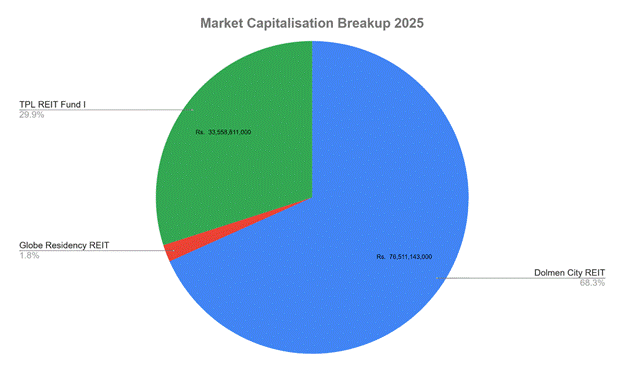
Market Capitalisation serves as a critical indicator of investor confidence in the Pakistani capital market. In this nascent sector, rising valuations signal growing institutional adoption and a pivot away from informal real estate holdings.
The sector has seen a significant aggregate increase in value from 2021 through the 2025 projections. Dolmen City REIT, the sector’s cap-weighted anchor, is projected to see its market cap rise from Rs. 57.4 Billion in 2021 to Rs. 76.5 Billion by 2025. Simultaneously, the entry of TPL REIT Fund I in 2024, with a valuation exceeding Rs. 32.8 Billion, significantly bolstered the total market size.
However, a regional comparison reveals a massive untapped potential. Pakistan’s REIT Market Cap as a percentage of Total Market Cap stands at a mere 0.35%. This is the lowest in the region when compared to Dubai (19.39%), Vietnam (14.56%), Singapore (7.30%), and even India (1.70%). The "So What?" behind recent gains is not just the growth of individual funds like Globe Residency REIT (rising from Rs. 0 to nearly Rs. 2 Billion), but the realization that Pakistan is at the very beginning of a multi-decade catch-up trade relative to regional peers.
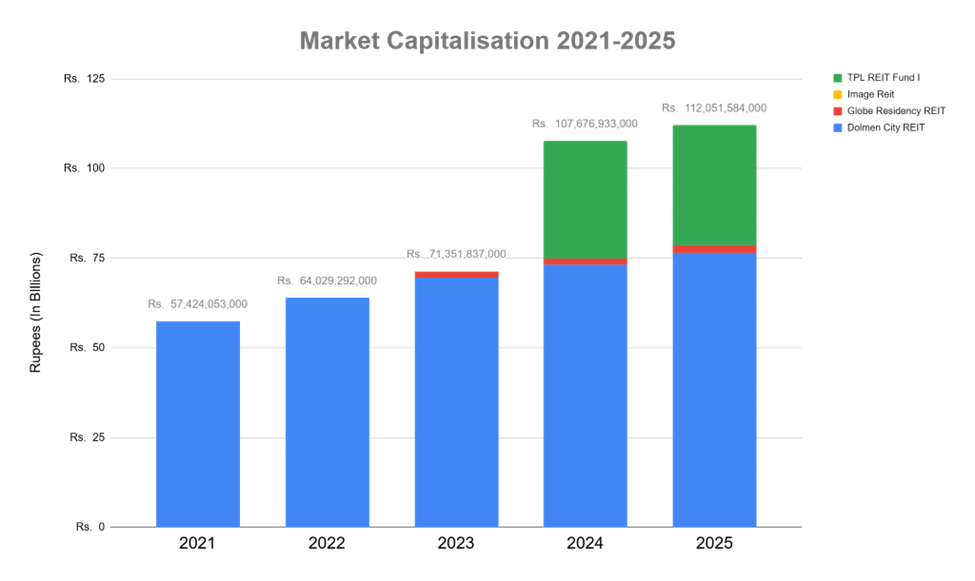
In summary, while the increasing aggregate market cap reflects a move toward documentation, the sector remains significantly under-represented in the national index, suggesting substantial headroom for future listings.
Performance Analysis: Revenue and Net Income Trends
Operational performance in the REIT sector is defined by the contrast between the recurring stability of Rental REITs and the cyclical, high-margin nature of Developmental REITs.
Revenue Trends
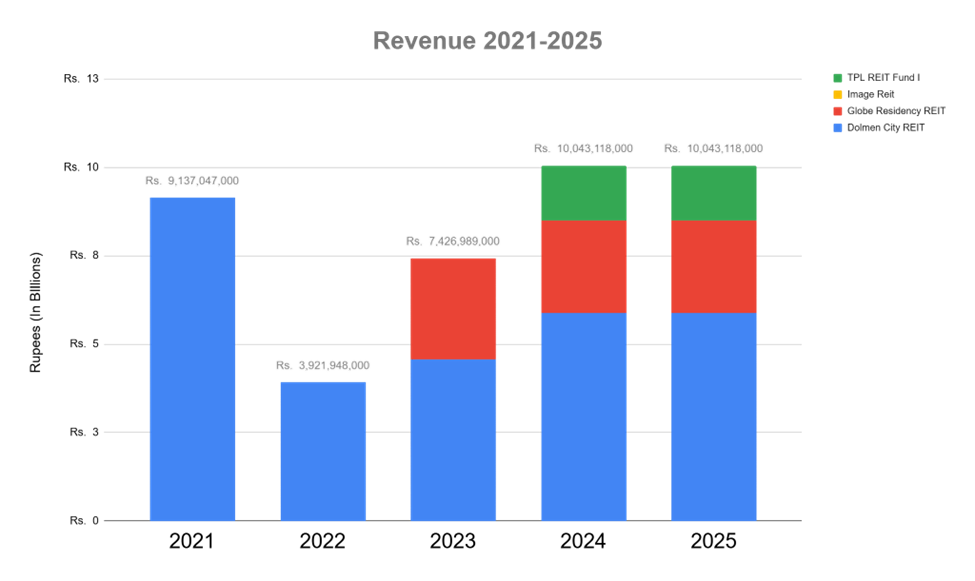
Revenue trajectories vary by project lifecycle. Dolmen City REIT experienced a revenue peak in 2021 at Rs. 9.1 Billion before stabilizing in the Rs. 4.5B to Rs. 5.8B range through 2025. Conversely, Globe Residency REIT has maintained a consistent revenue contribution between Rs. 2.6B and Rs. 2.8B since 2023, reflecting the phased execution of residential development milestones.
The "Dolmen Disconnect" and Income Trends
A critical observation for investors is the disconnect between Market Cap and Net Income for the sector's largest player. While Dolmen City REIT’s market valuation is projected to grow through 2025, its Net Income is projected to be lower in 2025 (Rs. 7.9 Billion) than its 2022 peak (Rs. 9.7 Billion). This suggests that revenue growth is not currently translating to bottom-line expansion, likely due to cost-push inflation affecting commercial operating expenditures.
In contrast, developmental models are showing significant growth momentum. Globe Residency REIT is projected to double its net income from Rs. 271 Million in 2023 to Rs. 539 Million by 2025.
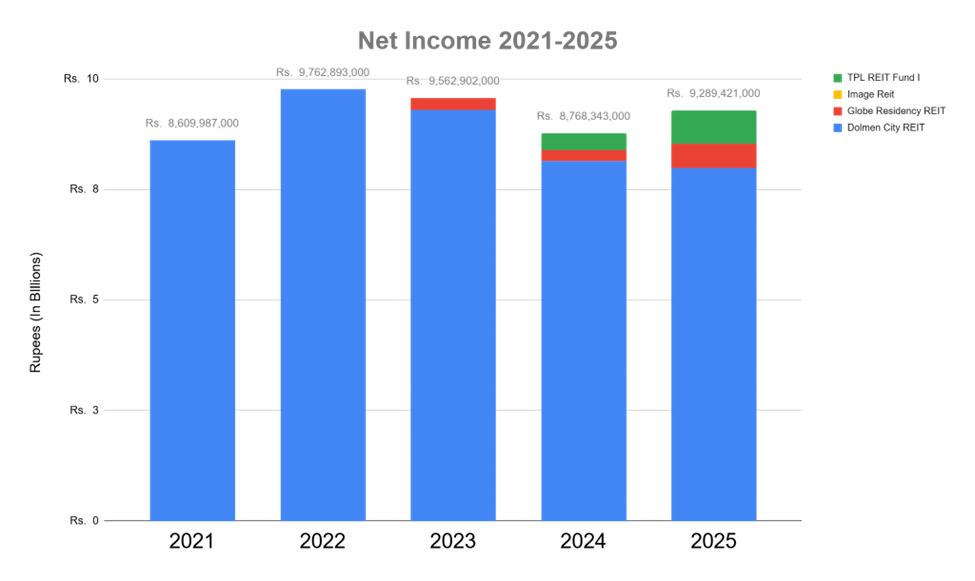
These trends indicate that while rental assets offer "trophy" stability, developmental REITs are currently providing the most aggressive earnings growth. This shift suggests a move toward more documented, sustainable earnings across the real estate business.
Performance Ratio Analysis
For institutional investors, efficiency ratios are the "North Star" for comparing REITs against traditional fixed-income instruments or the KSE100 index.
Margin and Efficiency Trends
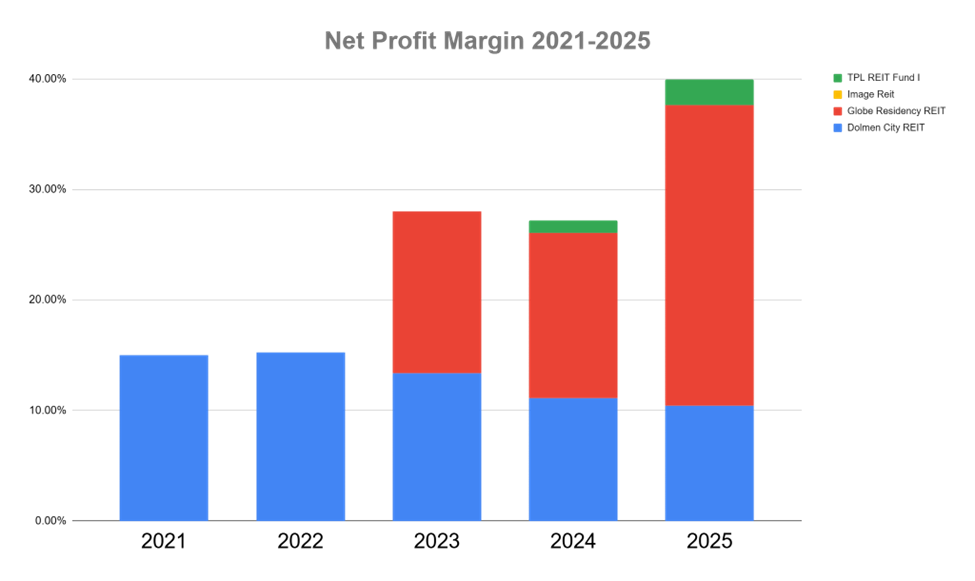
We observe a tale of two strategies: Dolmen City REIT has seen its net margin compress from 14.99% in 2021 to a projected 10.45% in 2025. Meanwhile, Globe Residency REIT is showcasing significant margin expansion, projected to reach 27.21% in 2025. This expansion highlights the superior profitability of developmental projects as they reach maturity.
Leverage and Returns
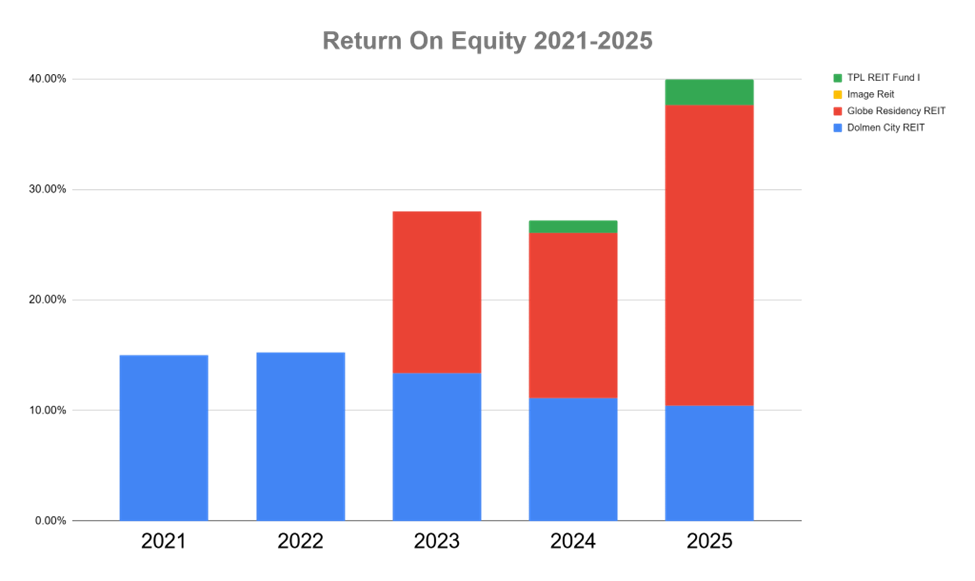
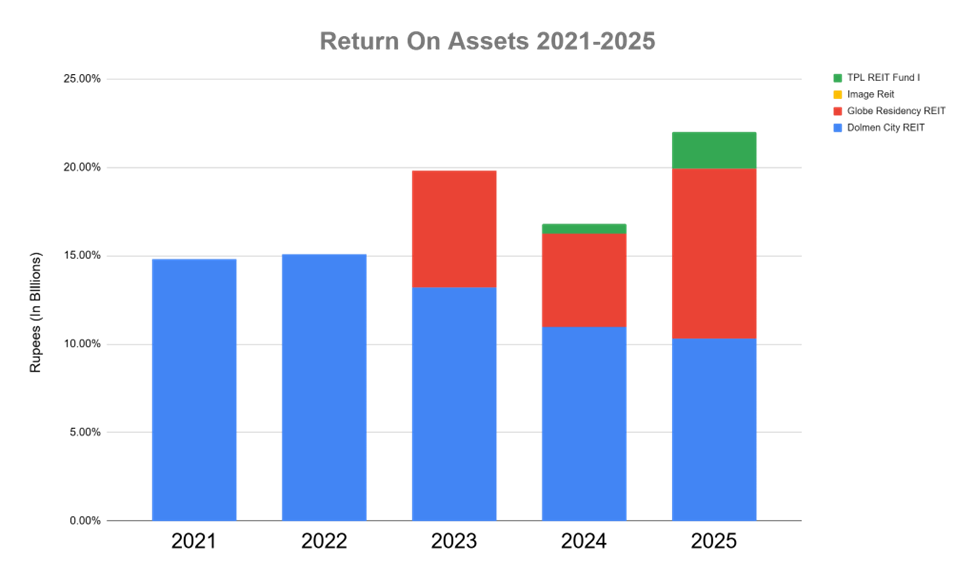
A striking feature of the sector is the near-identical nature of ROA and ROE (e.g., Dolmen’s 2025 ROE of 10.45% vs. ROA of 10.32%). This technical correlation implies exceptionally low leverage levels. While this reduces financial risk, it also suggests that REITs are currently under-utilizing debt, leaving room for enhanced returns through optimized capital structures in the future.
Regulatory and Macro Benchmarks
The State Bank of Pakistan (SBP) has significantly improved institutional liquidity by lowering risk weights on REIT investments from 200% to 100%. This effectively halves the capital requirement for banks to participate. When compared to traditional benchmarks (2015-2023), REITs remain highly competitive:
- REITs (DCR): 14.37%
- 10-Year Bond: 10.43%
- CPI (Inflation): 9.75%
- KSE100: 2.55%
REITs have consistently provided a superior risk-adjusted return profile, outperforming both inflation and the broader equity market.
Industry-Level SWOT Analysis
The macro-economic environment of 2024–2025 is defined by urbanization and demand for civic infrastructure, set against a backdrop of economic volatility.
SWOT Analysis
| Strengths | Weaknesses |
• Transition to "Democracy, Discipline, and Documentation." • Significant SBP regulatory support and risk-weight reduction. • Transparent governance via RMC structures. | • Critical lack of formal financing for the real estate sector. • Shortage of specialized expertise and awareness in REIT management. • Low regional market cap penetration (0.35%). |
| Opportunities | Threats |
• Demand from urbanization and nuclear family trends. • RWA Tokenization via blockchain to enable retail participation. • Mobilization of savings for productive civic infrastructure. | • Persistent domination of the undocumented real estate segment. • Excessive transaction-level taxation and policy inconsistency. • Currency depreciation impacting construction costs and margins. |
The Millennium of REITs
There is a growing sentiment within the industry that we are entering the "Millennium of REITs" in Pakistan. The sector holds the key to addressing the national housing shortage and revitalizing 100+ related industries. However, long-term success is not an absolute certainty; it hinges on the restoration of enabling tax provisions, specifically Section 99A of the ITO 2001, and the mitigation of financing bottlenecks. For the professional investor, REITs represent the most viable path to capturing the intrinsic value of Pakistan’s emerging urban infrastructure.
Disclaimer: This content is published solely for awareness, educational, public information, and journalistic purposes. All data is sourced from Pakistan Stock Exchange (dps.psx.com.pk) and relavant companies website.