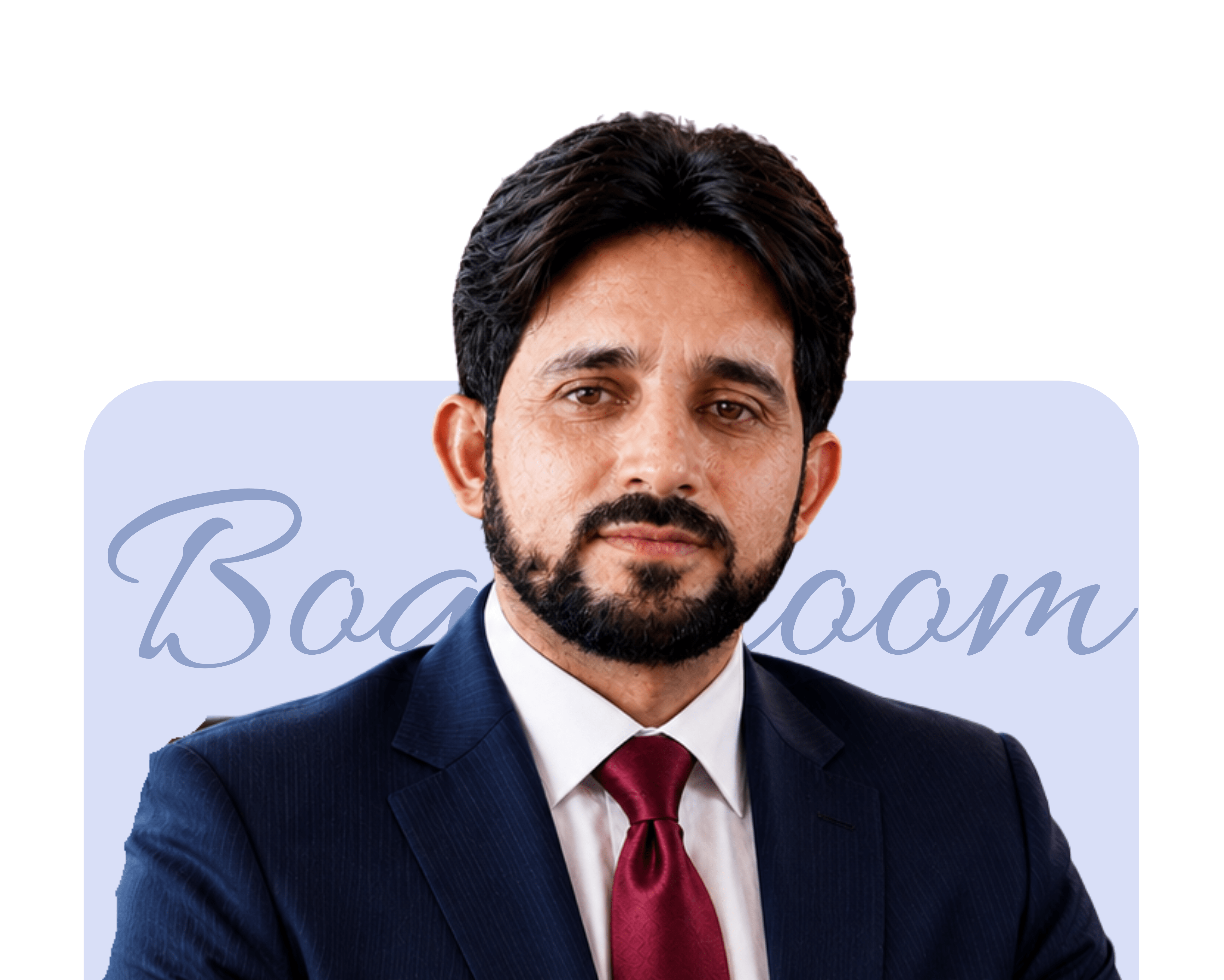
An executive leader, researcher, and Founder of Curvions Lab, Syed Muddassir believes true leadership extends beyond business success. Through his work in governance, organizational architecture, and institutional development, he advocates for building organizations rooted in integrity, innovation, and long-term impact—creating value that endures well beyond individual leadership.
BOARDROOM: Kindly share your professional journey and what inspired you to pursue this profession?
Syed Muddassir: I was born into a family where the pursuit of knowledge was valued more highly than the pursuit of wealth. For generations, scholarship shaped our family's identity, and my father envisioned a future for me as an Islamic scholar.. My early education therefore began with memorizing the Holy Qur'an and studying the Islamic sciences. Those early years shaped far more than my education. They taught me discipline, reflection, and the habit of searching for first principles rather than accepting superficial explanations. More importantly, they instilled in me a lifelong desire to benefit others. One principle from the teachings of Prophet Muhammad صلى الله عليه وسلم has remained with me throughout my life: "The best among you are those who benefit others." Although my profession changed, that purpose never did. As I grew older, my aspirations changed. I believed public service was the best path to contribute to society and hoped to become a civil servant. Life, however, had different plans, and that opportunity never materialized. Like many young professionals, I entered the business world as a sales professional to build a career and earn a living. At that stage, I never imagined becoming a senior executive. My ambition was simply to become a capable manager and contribute wherever I could. What remained constant, however, was my desire to create value for others. Over time, I realized that well-led organizations can improve lives at a scale comparable to public institutions. They create employment, develop people, solve meaningful problems, and strengthen society. That realization fundamentally changed my understanding of leadership. As my responsibilities grew, so did my curiosity. I became less interested in products and more interested in organizations themselves—why some continue creating value across generations while others decline despite having talented people and abundant resources. That curiosity eventually led me toward governance, institutional capability, and organizational architecture. Today, my work extends beyond executive leadership into research and writing because I believe knowledge creates value only when it is shared. Through my work, I hope to contribute ideas that help leaders build stronger organizations, develop enduring institutions, and create greater value for society. Ultimately, my work is driven by a simple question: Why do some institutions continue creating value across generations while others decline despite having talented people and abundant resources?
BOARDROOM: How would you describe your leadership style, and how has it evolved over the years?
Syed Muddassir: If you had asked the people who worked with me between 2013 and 2016 to describe my approach, many would probably have called me a strict manager or a disciplined administrator rather than a leader. At that stage of my career, I believed results came primarily through authority, control, and ensuring that work was completed. Over time, however, I began to notice something uncomfortable. While people respected my position, not many genuinely enjoyed working with me. My first instinct was to look for the fault in others rather than in myself. Eventually, I accepted that the person who needed to change was me. One teaching of Prophet Muhammad صلى الله عليه وسلم profoundly reshaped my understanding of leadership. He taught that those under our responsibility should be treated as our brothers—with dignity, compassion, and justice. That principle challenged me to rethink what leadership truly means. I came to understand that authority may secure compliance, but it rarely earns commitment. Leadership is not about exercising power over people; it is about accepting responsibility for the people entrusted to you. Results matter, but the way we achieve them matters just as much. From that point onward, I consciously shifted from directing people to developing them. I became far more intentional about coaching, mentoring, listening, and creating an environment where people could grow rather than simply perform. That transformation also changed how I viewed leadership itself. I came to believe it evolves through three stages: self-leadership, people leadership, and institutional leadership. The first requires mastering one's own character and discipline. The second is about enabling others to grow and succeed. The third, and in my view the highest form of leadership, is building governance, culture, and systems that continue creating value long after individual leaders have moved on. Looking back, my leadership journey has really been a journey of self-transformation. The more I studied leadership, the more convinced I became that every lasting institution is built upon leaders who are first willing to transform themselves.
BOARDROOM: What has been the most difficult decision you have made in your professional life, and what did you learn from it?
Syed Muddassir: One of the most difficult decisions of my career was closing a venture I had founded to help students and fresh graduates improve their employability. From the outset, my ambition was to build an organization that created meaningful social impact. Financial sustainability was essential, but it was never the reason the organization existed. As the venture evolved, however, it became clear that the investors and I held fundamentally different definitions of success. Neither perspective was wrong—we were simply trying to build two different organizations. After considerable reflection, I chose to close the venture rather than compromise the principles on which it had been founded. It was an emotionally difficult decision because it meant walking away from years of effort, relationships, and opportunity. Looking back, I have never regretted that decision because it taught me one of the most important lessons of my professional life: purpose alone is never enough. Sustainable organizations require alignment between purpose, governance, ownership, strategy, and investor expectations. When those elements move in different directions, even talented people and the best intentions struggle to create lasting impact. That experience fundamentally shaped my thinking about organizational architecture. It reinforced my belief that enduring institutions are not built on ambition alone, but on clarity of purpose, aligned governance, and shared values from the very beginning. It also influenced the thinking behind Curvions—derived from Curiosity, Curves, and Vision—a name that reflects my belief that meaningful progress begins with curiosity, follows a nonlinear path, and ultimately requires a clear vision. Perhaps the greatest lesson was that leadership sometimes requires the courage to walk away from something good in order to remain faithful to something more important. Success is measured not only by what we build, but also by the principles we refuse to compromise.
BOARDROOM: Every leader faces setbacks. Can you please share an example of how you navigated a major challenge and built resilience from it?
Syed Muddassir: One of the most significant setbacks in my professional journey came while building a venture with an ambitious vision for regional growth. Looking back, one of my biggest mistakes was entering the partnership too quickly. We shared ambition, but we had not invested enough time understanding whether we were truly aligned in our values, leadership philosophy, and definition of success. As we worked together, it became clear that we viewed leadership differently. I believed sustainable growth should be built on strong governance, trust, and institutional foundations. I also believed leaders should inspire people to believe in a shared vision while encouraging them to question ideas with logic and evidence. If I overlook something or make a mistake, I expect people to challenge my thinking respectfully rather than agree simply because I hold a leadership position. That experience taught me an invaluable lesson: shared ambition does not automatically mean shared principles. Founder alignment is not just about agreeing on a business opportunity; it is about aligning on values, governance, decision-making, and what success ultimately means. Rather than allowing the experience to discourage me, I chose to learn from it. Today, I spend far more time evaluating alignment before making important commitments because I have learned that organizations rarely become stronger than the principles upon which their founders are united. For me, resilience is not about avoiding setbacks. It is about having the courage to confront uncomfortable truths, accept responsibility for your own mistakes, and emerge with better judgment than before.
BOARDROOM: In your view, what role do governance, ethics, and accountability play in building sustainable organizations?
Syed Muddassir: I particularly appreciate this question because it sits at the heart of both my professional experience and my ongoing research. Over the years, I have become convinced that organizations rarely fail because they lack talent, strategy, or ambition. More often, they decline because governance, ethics, and accountability gradually become optional rather than foundational. For me, governance is not about policies, bureaucracy, or compliance. It is the discipline that keeps an institution faithful to its purpose, especially when short-term pressures tempt leaders to compromise. It transforms values from statements on a wall into standards that consistently guide decisions. Ethics provides the moral compass, governance provides the system, and accountability ensures that no one—not founders, executives, or boards—is above those standards. The moment accountability becomes selective, trust begins to erode, regardless of how successful an organization appears from the outside. One question has increasingly shaped my thinking: Are we building profitable enterprises, or institutions that society will continue to trust long after we are gone? Profitability, growth, and market leadership are essential, but they are outcomes. Strong governance is what gives an organization resilience and longevity, enabling it to create value across generations rather than depending on the character or presence of a single leader. That is why governance has become the central focus of my work and research. My aspiration is to help leaders build institutions where trust is embedded in the way the organization is designed, ethics is reflected in everyday decisions, and accountability applies equally to everyone. To me, that is the true measure of leadership—not simply building a successful business, but building an institution that continues to serve society long after its leaders have moved on.
BOARDROOM: How do you balance tradition with innovation, especially in an environment where disruption is constant?
Syed Muddassir: Every organization exists to serve someone—customers, employees, partners, or society. The moment it loses the ability to meet their evolving needs, it begins to lose its relevance. That is why I no longer see disruption as a choice or even as a competitive advantage. In today's environment, the ability to adapt is simply the price of remaining relevant. However, adaptation should never come at the expense of an organization's principles. Innovation belongs to products, technologies, business models, and ways of working, while principles such as integrity, accountability, fairness, and trust should remain constant. Organizations that sacrifice these principles may achieve short-term success, but they often undermine the very trust that sustains long-term performance. In my view, enduring organizations understand the difference between what should never change and what must continuously evolve. Values provide stability; innovation creates progress. The ability to distinguish between the two allows institutions not only to survive disruption but to continue creating value across generations. Innovation determines whether an organization remains relevant. Principles determine whether it remains trusted. Sustainable organizations never choose between the two—they build their future on both.
BOARDROOM: What strategies do you use to motivate and empower your teams to perform at their best?
Syed Muddassir: Over the years, I have realized that people rarely perform at their best because they are constantly motivated by a leader. They perform at their best when they work in an environment built on trust. One principle has become central to my leadership philosophy: a leader should be judged by how accessible they are to their team. If people feel comfortable approaching me when they are stuck, uncertain, or have made a mistake—without fearing blame or judgment—I know we are building the right culture. If people choose to struggle in silence because they are afraid to approach their leader, then I believe the problem is not with the team; it is with the leadership. For me, accessibility goes beyond having an open-door policy. It means creating psychological safety, where asking for help is viewed as a strength, honest conversations are encouraged, and learning is valued more than protecting one's ego. I also encourage people to think independently rather than becoming dependent on me. My role is not to solve every problem myself, but to develop people's confidence, judgment, and capability so they can solve increasingly complex challenges on their own. When people grow, organizational performance naturally follows. Ultimately, I believe leadership is measured not only by the results a team achieves, but by the environment a leader creates. When people feel trusted, respected, and safe to learn, they rarely need to be motivated—they become motivated.
BOARDROOM: Who have been your mentors or role models, and what lessons have you carried from them into your own leadership?
Syed Muddassir: Interestingly, I never had a formal mentor early in my career, although I genuinely looked for one. Over time, I realized that some of my greatest teachers were people I could never meet personally but whose lives, decisions, and legacies I could study. I have learned from history in my own way. The list is far longer than I could mention here, but Marcus Aurelius taught me the importance of self-mastery, discipline, and leading myself before attempting to lead others. Above all, Prophet Muhammad صلى الله عليه وسلم profoundly shaped my understanding of leadership as an act of service, trust, justice, consultation, and institution building. Hazrat Umar ibn al-Khattab (RA) taught me the importance of governance, accountability, and building systems that endure beyond individuals. Khalid ibn al-Walid (RA) demonstrated the power of sound judgment, adaptability, and making the best use of available resources under constantly changing circumstances. Beyond these historical figures, I continue to learn from contemporary management thinkers, researchers, and practitioners. I believe wisdom is not confined to one era, one profession, or one discipline. Every generation has something valuable to teach if we remain humble enough to learn. Perhaps the greatest lesson I have carried from all of them is that leadership is not measured by the authority we accumulate, but by the responsibility we accept, the people we develop, and the institutions we leave stronger than we found them.
BOARDROOM: What do you see as the biggest opportunities and challenges for Pakistan's business ecosystem in the coming years?
Syed Muddassir: Pakistan's greatest strategic advantage is its people. With more than 46 million people between the ages of 15 and 24, we have one of the world's largest youth populations. Our young people are ambitious, increasingly connected to the global economy, and many possess strong English-language skills. If developed properly, this demographic advantage could become one of Pakistan's greatest economic strengths. History shows that no nation has achieved lasting prosperity without investing in education, research, and continuous learning. Whether we look at the United States, China, Singapore, or many European economies, long-term competitiveness has been built on strong educational institutions, research ecosystems, and a culture that continuously develops human capability. Unfortunately, this is also where I believe Pakistan faces its greatest challenge. Every year, hundreds of thousands of graduates enter the job market, yet employers continue to report difficulty finding people with the skills they actually need. The problem is not simply unemployment—it is the widening gap between education and employability. Technology has become one of the defining drivers of economic growth. Pakistan's ICT exports reached US$4.6 billion in FY2025–26, with freelancers making a significant contribution. That demonstrates the quality of our talent, but our ambition should go much further. We should aspire to transform individual success into globally competitive enterprises. Countries such as Indonesia and Brazil have built ecosystems that consistently convert local talent into globally recognized companies and unicorns through entrepreneurship, investment, governance, research, and access to capital. Pakistan has the talent; our next challenge is building the institutions that enable that talent to scale into globally competitive organizations. This places a shared responsibility on leaders in business, education, and government. Our role is not only to create jobs but to build institutions that develop talent through learning, mentoring, research, and innovation—equipping young people to solve meaningful problems and build organizations that outlive them. Ultimately, I believe Pakistan's future will not be determined by the size of its youth population alone, but by the quality of the institutions that educate, develop, and empower that talent. Demographics create potential; institutions transform that potential into lasting prosperity.
BOARDROOM: What advice would you give to young professionals and entrepreneurs who aspire to leadership roles?
Syed Muddassir: The first piece of advice I would give is: don't chase leadership—prepare yourself for it. Early in my career, I believed leadership was about position and authority. Over time, I realized that titles can be given overnight, but credibility and trust are earned over many years. Secondly, never stop learning. The world is changing faster than ever, and your greatest competitive advantage is not what you already know, but your ability to continuously learn, unlearn, and adapt. Invest in knowledge, read widely, seek different perspectives, and remain curious throughout your career. I would also encourage young professionals to think beyond building successful careers. Ask yourself what problems you want to solve and what legacy you want to leave behind. Careers create personal success; institutions create societal impact. One concern I often hear from young people is that opportunities are available only through sifaarish (personal connections). While relationships and networks can certainly open doors, they rarely determine how far you go. Throughout my own career, I have seldom received an opportunity solely because of a reference. At best, a recommendation may bring you to the table; from that point onward, your attitude, integrity, willingness to learn, adaptability, and the value you create determine whether you earn your place. So, instead of chasing influential people, focus on building your credibility. Credibility is the strongest recommendation anyone can have. A connection may open a door, but your character, competence, and consistency determine whether new opportunities continue to open throughout your career. Leadership is not about becoming important. It is about becoming the kind of person whom others willingly trust with responsibility.
BOARDROOM: How do you maintain a balance between professional responsibilities and personal well-being?
Syed Muddassir: To be honest, I haven't always been successful at maintaining that balance. Like many leaders, there have been periods in my career when work consumed far more of my time than it should have. Looking back, I have realized that sustained performance requires sustained well-being. Today, I consciously try to maintain healthier boundaries. I have come to believe that productivity is not measured by how many hours we work, but by how focused and effective we are during those hours. Rest is not the opposite of productivity; it is one of the conditions that makes high performance possible. I also dedicate time each week to learning and personal research because continuous learning keeps my thinking fresh. Weekends are primarily reserved for family, while spirituality and self-reflection help me stay grounded and remind me that there is a purpose beyond work. I am still learning to strike the right balance, but one lesson has become very clear to me: if we neglect our physical, emotional, or spiritual well-being, our ability to lead others eventually begins to suffer. Taking care of ourselves is not a luxury or a distraction from leadership—it is part of our responsibility as leaders.
BOARDROOM: Looking back, what impact do you hope to leave behind on your industry, organization, or community?
Syed Muddassir: If people remember me only for the organizations I helped build or the results I delivered, I would consider that an incomplete legacy. What I truly hope to leave behind is a way of thinking—a belief that organizations should aspire to become institutions, and that leadership should be measured not only by quarterly performance, but by the systems, culture, and governance we leave behind for future generations. Throughout my career, I have become increasingly convinced that individuals create momentum, but institutions create civilizations. Leaders come and go, markets change, and technologies evolve, yet strong institutions continue creating value because they are built on enduring principles rather than individual personalities. If my work, research, or writing encourages even a few leaders to think differently about governance, organizational architecture, and institutional leadership, I will consider that a meaningful contribution. Success is temporary; impact through institutions is what endures. This belief also inspired the name Curvions—a combination of Curiosity, Curves, and Vision. My aspiration was never simply to build a company, but a platform where people, particularly young professionals from emerging economies, could learn, grow, and create opportunities for themselves and others. I believe the greatest investment any nation can make is in developing its people because knowledge and wisdom remain the most powerful forms of empowerment. Ultimately, I hope to be remembered not for the positions I held or the organizations I led, but for helping build institutions, developing leaders, and creating opportunities that continue generating value—institutions strong enough to thrive beyond any individual leader.