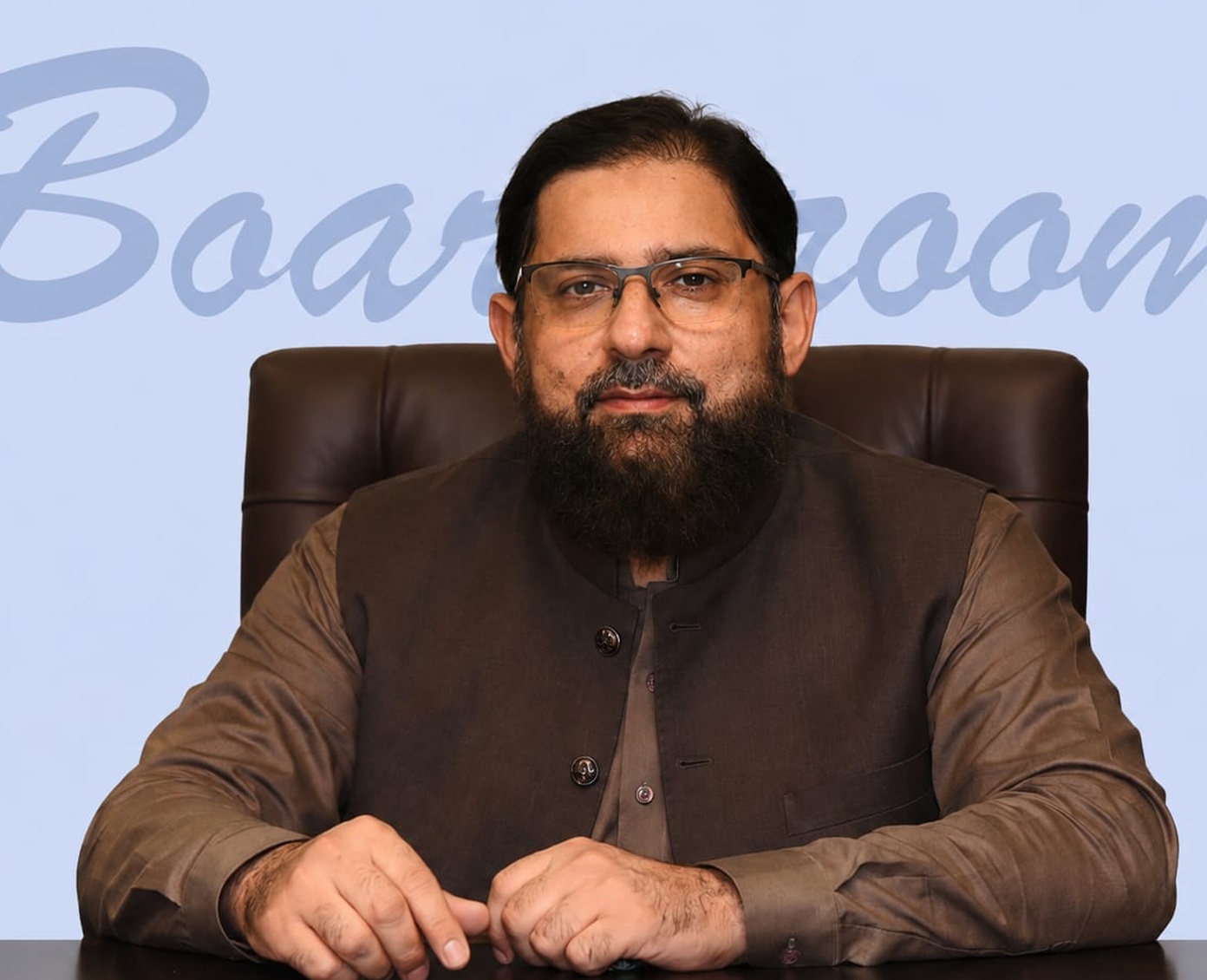

Ashfaq Hashmi, Founder of Leading Technologies, has built a career defined by resilience, adaptability, and a people-centric leadership philosophy. Beginning at General Foods and later moving through hospitality and industrial sales with the Marine Group of Companies, he gained diverse experience before venturing into entrepreneurship. At Leading Technologies, he has partnered with multinational corporations, combining financial performance with a commitment to ethics and social impact. Guided by the values of mentorship and family legacy, Ashfaq emphasizes empowerment, innovation, and accountability. His vision extends beyond business success—towards creating sustainable organizations that inspire future generations of leaders.
Boardroom: Kindly share your professional journey and what inspired you to pursue this career?
Ashfaq Hashmi: My professional journey has been defined by determination, continuous learning, and the ability to adapt to challenges. I began my career at General Foods in Islamabad, before moving to the hospitality sector as Manager of Food and Beverages at Best Western Hotel, Islamabad. From there, I transitioned to the Marine Group of Companies, one of Pakistan’s largest business conglomerates, where I advanced to become Head of Sales for the Punjab region within its industrial supplies division. During this time, I had the privilege of serving a diverse spectrum of industries across the region. Eventually, I chose to pursue my entrepreneurial ambitions and founded Leading Technologies. Through Leading Technologies, I have had the opportunity to collaborate with MNCs in the corporate sector. What began as a vision to create meaningful impact in my industry and community has since evolved into a mission to build an organization that delivers strong financial performance while contributing positively to society at large.
Boardroom: How would you describe your leadership style, and how has it evolved over the years?
Ashfaq Hashmi: For me, leadership is fundamentally about empowerment. Earlier in my career, I leaned toward a more directive style; however, with greater responsibilities came the realization that true progress stems from collaboration and trust. Today, my leadership philosophy is participative, focused on creating an environment where teams feel valued, inspired, and empowered to innovate with confidence.
Boardroom: What has been the most difficult decision you have made in your professional life, and what did you learn from it?
Ashfaq Hashmi: One of the most challenging decisions I faced was crafting distinct sales strategies for local and multinational companies, given their fundamentally different approaches to business. That experience reinforced my belief that every challenge is an opportunity to learn. The key lies in staying resilient, trusting one’s instincts, and making decisions grounded in values rather than driven by fear.
Boardroom: Every leader faces setbacks. Can you share an example of how you navigated a major challenge and built resilience from it?
Ashfaq Hashmi: Yes, the uncertainty in the country’s fiscal landscape made pricing our biggest challenge. In our sector, compromising on quality is never an option, as it could have disastrous consequences for our clients. While we did face difficulties, I constantly reminded myself and my team that setbacks are not failures but valuable lessons. By staying agile, embracing innovation, and maintaining transparent communication, we were able to overcome the challenge and emerge stronger.
Boardroom: In your view, what role do governance, ethics, and accountability play in building sustainable organizations?
Ashfaq Hashmi: Governance, ethics, and accountability form the backbone of organizational sustainability. Governance provides direction, ethics safeguard credibility, and accountability ensures consistent growth. For me, these principles are non-negotiable and integral to long-term success.
Boardroom: How do you balance tradition with innovation, especially in an environment where disruption is constant?
Ashfaq Hashmi: It’s about respecting the foundations that brought us here, while not being afraid to evolve. Tradition anchors us, while innovation propels us forward. The balance comes when you encourage creative solutions without losing sight of your core values.
Boardroom: What strategies do you use to motivate and empower your teams to perform at their best?
Ashfaq Hashmi: I believe in creating an environment where people feel ownership of their work. Incentives, recognition, and continuous professional development play an important role but above all, it’s about trust, giving people space to excel while supporting them when needed.
Boardroom: Who have been your mentors or role models, and what lessons have you carried from them into your own leadership?
Ashfaq Hashmi: My beloved father, the late Mushtaq Ahmad, left an indelible mark on every aspect of my life. He was the embodiment of love, care, and hard work, with family at the very center of his existence. Whatever I have achieved today is a reflection of his values and guidance, and I consider myself deeply fortunate to have had him as my father. I could speak endlessly about his influence, as he was truly one of a kind.
In my professional journey, I must also acknowledge Respected Iqbal Hashmi, whose mentorship fueled my motivation, honed my skills, and refined my client management abilities. I have been privileged to learn from such remarkable mentors. They taught me that humility, resilience, and empathy are as vital to leadership as strategy and execution, principles that continue to guide my decisions and leadership philosophy.
Boardroom: What do you see as the biggest opportunities and challenges for Pakistan’s business ecosystem in the coming years?
Ashfaq Hashmi: Pakistan holds immense potential, driven by its young population and entrepreneurial spirit. However, the real challenge lies in achieving political stability, as it directly shapes economic policies and the broader business landscape, ultimately determining economic stability. We must recognize that doing business is alike to participating in an ecosystem, where every component plays a critical role in maintaining equilibrium. A single disruption can unsettle the entire system. To put it concisely, while we have a long journey ahead, several pressing reforms remain essential: tax reforms, restructuring of administrative frameworks, continuity of policies, depoliticization of financial institutions, development of skilled labor, industry alignment, and above all, addressing the ethical responsibilities of all stakeholders. If these challenges are met with seriousness and consistency, Pakistan’s future holds tremendous promise.
Boardroom: What advice would you give to young professionals and entrepreneurs who aspire to leadership roles?
Ashfaq Hashmi: Stay curious, keep learning, and never compromise on integrity. Success does not come overnight; it is built over years of perseverance. Embrace failures as stepping stones and focus on building value, not just wealth.
Boardroom: How do you maintain a balance between professional responsibilities and personal well-being?
Ashfaq Hashmi: Balance is crucial. I make time for family, health, and reflection, because leadership is not sustainable without personal well-being. When leaders are balanced, they inspire healthier, more productive teams.
Boardroom: Looking back, what impact do you hope to leave behind on your industry and future generations?
Ashfaq Hashmi: I hope to be remembered not just for business success but for contributing to an ecosystem where ethics, innovation, and inclusivity drive progress. If my journey inspires the next generation to dream bigger and work with purpose, I would consider it my greatest legacy.